
The Warnock Years
Part 3 — Fine Margins (2006–2007)

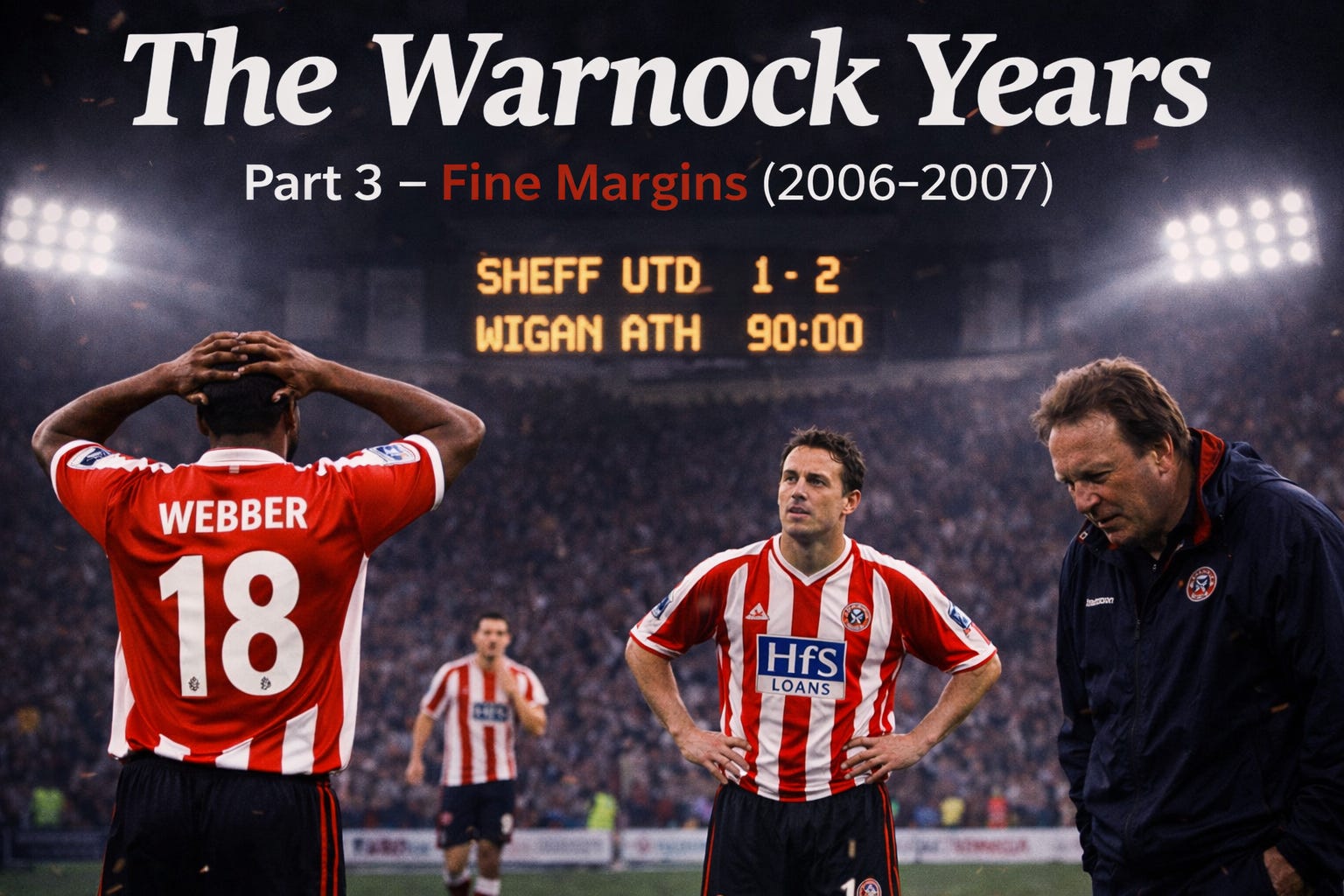
Promotion brings relief.
The Premier League removes it.
After the control of the previous season, Sheffield United stepped into a division where nothing came without cost. The margins were thinner, the punishments quicker, and the space for error almost non-existent.
It didn’t take long to see both sides of that.
The seventh game brought the first win—Middlesbrough at Bramall Lane—felt like a release. Not just because it was needed, but because of how it came. Deep into added time, with the game drifting, Phil Jagielka stepped forward and hit one from 30 yards.
It wasn’t worked. It wasn’t controlled.
It was taken.
And in this division, that matters.
But for every moment like that, there was a reminder of how quickly things could turn.
The win against Arsenal captured that balance perfectly. A result built on discipline and resilience, but remembered just as much for what followed. When Paddy Kenny went off injured, Jagielka ended up in goal for the final half hour.
Outfield player. Premier League match. Protecting a lead.
It should have unravelled.
It didn’t.
And that, more than anything, summed up United that season. They weren’t out of place. They weren’t overwhelmed. They found ways to compete, even when the situation demanded something completely outside the norm.
Which is why the way it unfolded still feels unresolved.
Because survival wasn’t lost in one moment. It was chipped away at.
There were results that could have gone either way and didn’t. Fine margins, consistently falling just the wrong side.
And running alongside all of it was something else entirely.
The Tevez affair didn’t define every week, but it never went away. It sat in the background, then moved into the foreground and, by the end, it was impossible to separate from the outcome.
Not just because of the player—but because of everything around it.
Decisions.
Interpretations.
And, increasingly, a sense that the playing field wasn’t entirely level.
Other results only added to that feeling. Teams facing United’s relegation rivals making changes that, at the very least, raised eyebrows. At this level, where every point carries weight, those details matter.
And they linger.
By the final day, it had all condensed into something brutally simple.
Wigan Athletic.
A draw was all that was needed. Anything less, and it was out of their hands.
United fell behind, responded, and brought it back level. For a moment, it felt like momentum might carry them through one last time.
Then came the penalty.
David Unsworth.
The same player who, a year earlier, had scored a goal against Hull that had helped shape United’s promotion.
This time, the margins fell the other way.
2–1.
But even then, it never quite felt random.
It felt inevitable.
From the moment Danny Webber went clean through, struck his shot, and saw it hit the inside of the post, only to roll agonisingly across goal and away to safety.
All that was needed was a draw.
And that was the moment it slipped.
Elsewhere, the piece that had hovered over the entire run-in found its final, decisive moment.
West Ham. Old Trafford.
Tevez.
The goal.
When the table was finalised, the gap wasn’t dramatic. It rarely is.
One goal.
Goal difference.
That was it.
Not that Sheffield United weren’t good enough—
but that they were close enough for every detail to matter.
And, as had happened just over a decade earlier, almost every one of those details went the other way.
In the aftermath, the manager lost his job. The Warnock Years had come to an end.
This is No.16 in a series exploring how we describe football, then and now.
What do you remember about those seasons? Let me know in the comments or reply directly. I read every message.
If you enjoyed this piece and fancy supporting the writing, you can buy me a coffee here.
If you’d like to receive future essays, you can subscribe below.